
A basement wall rarely begins bowing overnight. Homeowners may first notice a horizontal crack, a wall that looks slightly out of plumb, or white mineral staining along the block. As outside soil becomes saturated and expands, it can push against the foundation with tremendous force. The decision between wall anchors versus braces matters because the right system must address both the wall’s condition and the pressure causing it to move.
A bowing foundation wall is not a cosmetic issue to cover with paint or patching compound. Left alone, continued movement can widen cracks, allow water into the basement, damage framing above, and eventually require a far more extensive repair. The good news is that many walls can be stabilized without full replacement when the problem is identified early and repaired with an engineering-based system.
Wall Anchors Versus Braces: The Core Difference
Wall anchors and steel braces are both designed to stabilize basement walls that are cracking, tilting, or bowing inward. They are not interchangeable solutions, however. Each works differently, requires different site conditions, and may be better suited to a particular degree of movement.
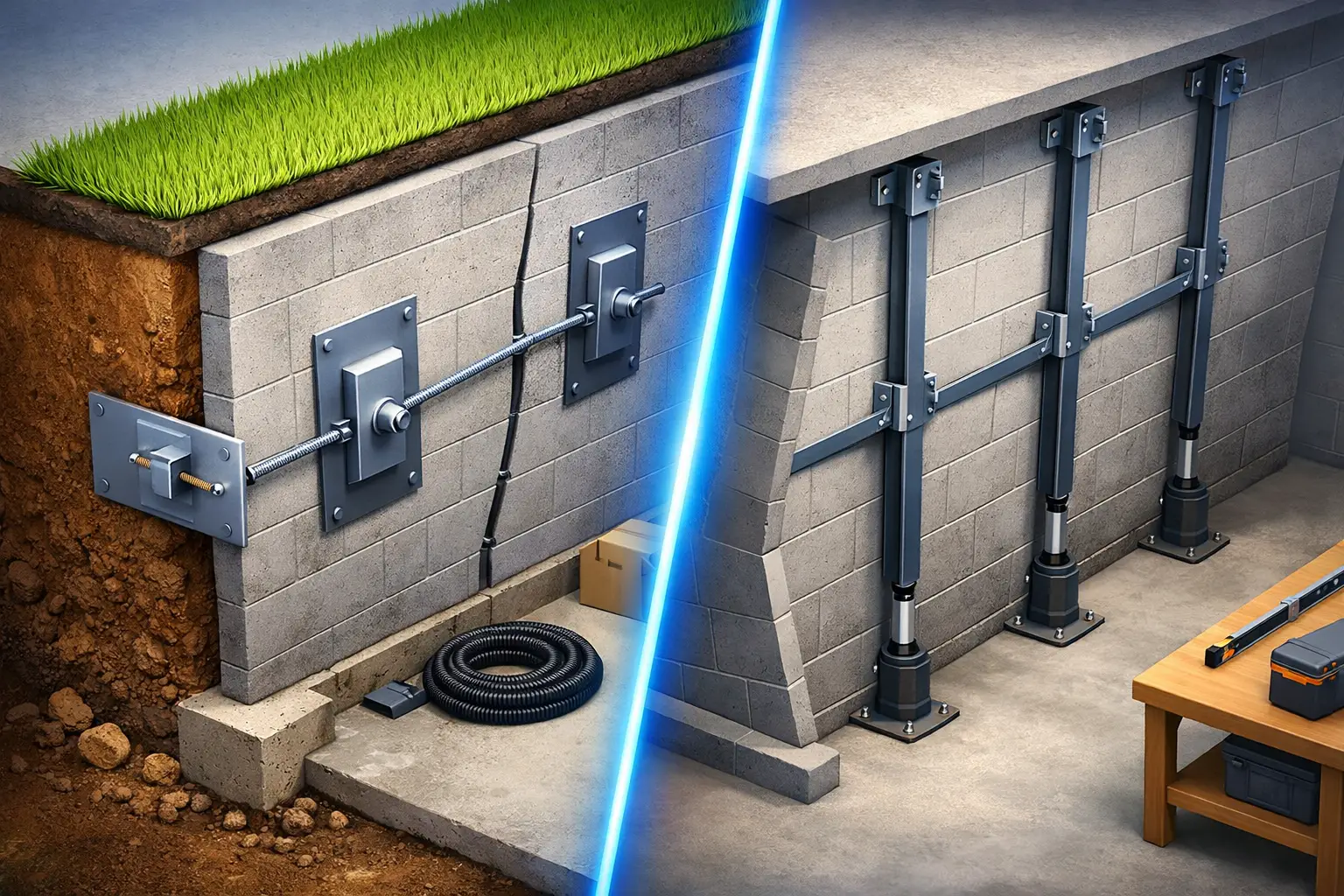
A wall anchor system uses heavy-duty steel plates connected by a steel rod. One plate is installed against the interior basement wall, while the other is installed in stable soil outside the home, typically several feet away from the foundation. The rod connects the two plates and is tightened to counteract the lateral pressure pushing the wall inward.
A brace system, often built with vertical steel I-beams, is installed along the inside face of the basement wall. The beams are secured at the top to the floor framing and at the bottom to the concrete slab. They create a rigid interior support that resists additional inward movement.
Put simply, wall anchors pull against stable soil beyond the pressure zone. Braces reinforce the wall from the inside. Both can provide lasting stabilization when properly designed and installed, but the best choice depends on what is happening around and beneath your home.
When Wall Anchors Are the Better Repair
Wall anchors are often a strong option for poured concrete or block basement walls with moderate inward movement. Because the system reaches beyond the problem soil near the foundation, it can provide powerful resistance to ongoing pressure.
One advantage is that anchors may allow for gradual wall improvement. After installation, the system can be adjusted over time as conditions allow. A wall that has bowed inward may not return perfectly to its original position, especially if movement has been present for years. Still, periodic tightening can sometimes reduce the bow and close a portion of the visible crack.
Anchors do require enough open, accessible land outside the affected wall. Driveways, patios, neighboring structures, steep grades, buried utilities, mature landscaping, or property-line limitations can make installation impractical. A professional inspection should confirm that the exterior anchor locations are safe and effective before this system is recommended.
Wall anchors are commonly appropriate when a homeowner has noticed horizontal cracking in a block wall, inward bowing across a broad section of the basement, or a wall that has moved but remains structurally repairable. They are especially useful when there is adequate exterior clearance and the goal is both stabilization and the possibility of gradual correction.
When Steel Braces Make More Sense
Steel braces are often the practical choice when exterior access is limited. If a basement wall sits beneath a deck, beside a driveway, close to a property line, or in an area where excavating for anchor plates would be disruptive, interior braces can deliver substantial support without requiring exterior excavation.
The vertical steel members distribute the force of soil pressure and prevent the wall from bending farther inward. They are frequently installed on a regular spacing across the affected section of wall, with the exact layout based on wall height, material, extent of deflection, and loading conditions.
Braces are primarily a stabilization system. Unlike adjustable wall anchors, they generally do not pull a bowed wall back toward its original position. That is not a drawback when the priority is stopping movement before it worsens. For many homeowners, preventing additional structural damage is the urgent goal.
A brace system may be recommended for walls with early to moderate inward movement, for homes with limited exterior working room, or when the wall configuration makes anchors less suitable. Proper attachment is critical. The system must transfer force safely into the basement slab and floor framing, not simply press steel against damaged masonry.
The Wall Condition Matters as Much as the Repair System
The visible crack is only one part of the diagnosis. Before choosing wall anchors or braces, an experienced foundation professional should evaluate the wall material, crack pattern, degree of bowing, moisture conditions, drainage, and the condition of the home’s framing.
Horizontal cracks often point to lateral soil pressure. Vertical cracks may be related to settlement, shrinkage, or water entry. Stair-step cracks in block walls can signal uneven movement. A wall that is leaning inward near the top can behave differently from a wall bowing at the center. These details affect the repair scope.
The amount of wall movement is also critical. A wall with slight deflection may be stabilized efficiently. A wall that has shifted significantly, is crumbling, has displaced blocks, or can no longer safely support the structure above may require a more involved structural restoration plan. No responsible contractor should recommend a one-size-fits-all repair based on a photograph alone.
Moisture must be part of the conversation. Expansive wet soil, poor grading, overflowing gutters, short downspouts, and water collecting near the foundation can all increase pressure against basement walls. Installing anchors or braces without addressing water management may stabilize the wall, but it does not eliminate the condition that helped create the problem. Permanent repair starts with the root cause.
Warning Signs That Should Not Wait
Call for a professional foundation inspection if you see a horizontal crack in a basement wall, inward bowing, loose or shifting masonry, water entering through foundation cracks, or recurring dampness along one wall. Doors sticking above the basement, new cracks in drywall, sloped floors, and gaps where trim meets walls can also accompany structural movement.
Pay close attention after extended rain, rapid snowmelt, or repeated freeze-thaw cycles. Virginia and Maryland homes often experience changing soil moisture throughout the year, and that movement can reveal or worsen a foundation problem. A crack that appears dry in summer may still be part of a larger pressure issue.
Do not assume a painted wall is sound because the crack is no longer visible. Previous patching can hide evidence without stopping the movement behind it. Similarly, avoid relying on temporary posts, surface sealants, or simple crack filler as a solution for a wall that is actively bowing.
What a Proper Recommendation Should Include
A trustworthy repair recommendation explains why one system fits your home better than another. You should understand the source of the wall pressure, the condition of the foundation, where the repair components will be installed, and whether drainage or waterproofing work is needed alongside structural stabilization.
It should also be clear about the goal. Is the system intended to stop further movement? Can it be adjusted over time? Is cosmetic crack repair part of the scope after the wall is stabilized? Honest answers matter because a permanent fix is more valuable than a reassuring promise that ignores site conditions.
At Foundation Works, inspections focus on the actual cause of the damage, not just the visible symptom. That means recommending wall anchors where exterior conditions and wall movement make them the right fit, and recommending interior braces when they provide the safer, more practical path forward.
A bowing wall does not always mean foundation replacement, but it does deserve prompt attention. If you have seen cracking, inward movement, or water pressure building along a basement wall, schedule a no-pressure professional assessment before the next wet season gives the problem more force to work with.

