
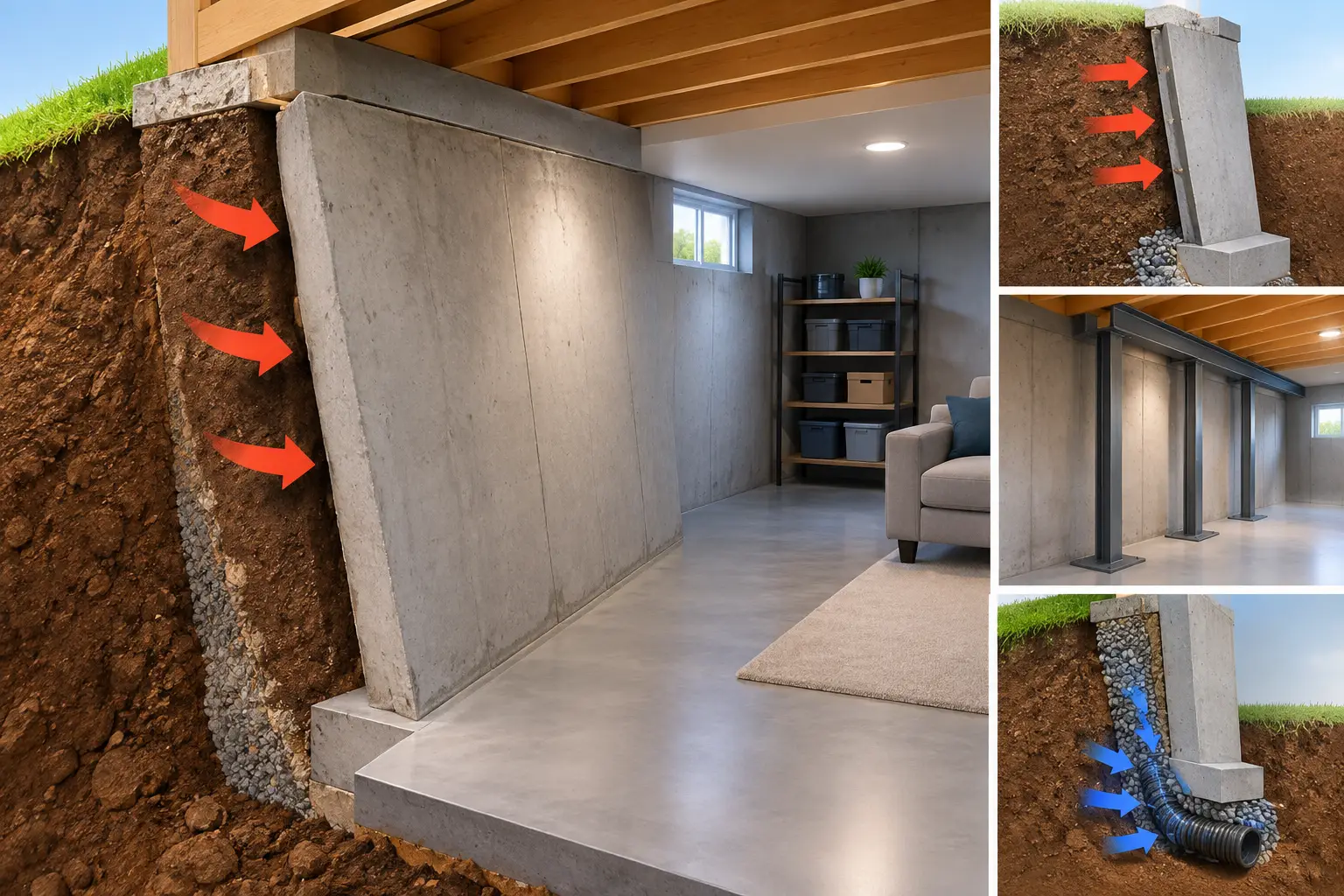
A basement wall rarely starts leaning inward overnight. Homeowners often first notice a horizontal crack, a faint bow across a block wall, or a basement that suddenly feels damp after heavy rain. Understanding why basement walls lean inward can help you act before soil pressure turns a manageable repair into a serious structural problem.
The short answer is pressure. The longer answer is that the soil and water outside your foundation can exert tremendous force against basement walls, especially in older homes or properties with poor drainage. A wall that was designed to carry the home above it is not meant to resist constant, increasing sideways pressure without support.
Why Basement Walls Lean Inward
The soil around your foundation is not static. It absorbs rain, dries out, freezes, thaws, and shifts with seasonal conditions. When that soil becomes saturated, its weight increases significantly. Water trapped in the ground also creates hydrostatic pressure, which pushes against the basement wall from the outside.
During wet periods, this pressure can build quickly. If gutters overflow near the foundation, downspouts discharge too close to the home, or the yard slopes toward the basement, large amounts of water can collect beside the walls. The more water the soil holds, the more force it places on the foundation.
Clay-heavy soil is especially troublesome in many parts of Virginia and Maryland. Clay expands when wet and shrinks as it dries. That repeated movement can create a cycle of pressure and release that gradually weakens the wall. Freeze-thaw cycles can add to the problem by expanding moisture in the soil during cold weather.
A basement wall may also lean inward because it was built with limited reinforcement, has deteriorated over time, or was backfilled with heavy soil before the framing above provided enough support. Masonry block walls are particularly vulnerable to horizontal pressure. Mortar joints can weaken, blocks can shift, and the wall can bow toward the basement interior.
Warning Signs That Pressure Is Affecting Your Foundation
A leaning wall is a structural warning sign, but the earliest symptoms can be easy to miss. Horizontal cracks are among the clearest indicators of outside soil pressure. They commonly appear along the middle portion of a block wall, where lateral force is often greatest.
You may also see stair-step cracks following mortar joints, a wall that curves inward when viewed from the side, or vertical cracks that widen near the top or bottom. In more advanced cases, individual blocks may begin to slide out of alignment, crumble, or separate from the floor framing above.
Water signs matter too. Damp walls, white mineral deposits, musty odors, puddles, and recurring moisture near the same section of wall may point to drainage problems that are increasing pressure outside. A wall can appear dry at the moment and still be under stress, so visible water is not the only measure of risk.
Inside the home, related movement may show up as sticking doors, cracked drywall, uneven floors, or gaps between trim and walls. These symptoms do not automatically mean the basement wall is failing, but they should be evaluated in context. Foundation problems are not one-size-fits-all, and an honest inspection should separate cosmetic cracking from active structural movement.
How Serious Is an Inward-Leaning Basement Wall?
It depends on the amount of movement, the type of wall, whether cracks are growing, and what is causing the pressure. A hairline crack that has remained unchanged for years may require monitoring and water management. A wall with a visible bow, widening horizontal crack, or shifting blocks needs prompt professional attention.
Waiting is rarely a good strategy when a wall is actively moving. Soil pressure does not resolve itself because the wall has cracked. In many cases, movement accelerates as the wall loses its ability to resist the load. What begins as a narrow crack can develop into major bowing, water intrusion, or partial wall failure.
The risk is not limited to the basement. Foundation walls support the structure above. As a wall moves, it can affect floor framing, exterior finishes, windows, doors, and the home’s overall value. If you are considering selling, visible foundation movement can also become a major issue during inspection negotiations.
The Repair Must Match the Cause
Painting over a crack, applying surface sealant, or covering the wall with finished materials does not stop the pressure outside. Cosmetic repairs can hide evidence of movement while allowing the underlying condition to worsen. A permanent solution begins with identifying why the wall is moving and whether that movement is ongoing.
For walls with limited to moderate bowing, engineered reinforcement systems may stabilize the wall and prevent further inward movement. Depending on the wall construction and site conditions, repairs can involve steel supports, wall anchors, or carbon fiber reinforcement. Each option has different strengths, installation requirements, and limits on how much correction is appropriate.
Wall anchors can be effective when there is adequate space outside the foundation to install an earth anchor in stable soil. They use resistance from the surrounding soil to counter the pressure pushing the wall inward. Interior steel reinforcement may be a practical choice when outside access is limited or when a wall needs added support along a specific span. Carbon fiber reinforcement can provide a low-profile option for certain walls with cracking or early-stage bowing, particularly when the wall surface needs to remain relatively clear.
Not every bowed wall should be forced back into place. Attempting to straighten a severely compromised wall without a proper repair plan can create additional damage. The goal is to stabilize the structure safely, address the forces causing movement, and determine whether partial straightening is suitable for the wall’s condition.
Water Management Is Part of Structural Protection
Since water is often a major contributor to lateral soil pressure, drainage should be evaluated alongside any structural repair. The right approach may include directing roof runoff away from the home, correcting grading that drains toward the foundation, and addressing groundwater or water intrusion around the basement.
This is where a diagnosis matters. A damp corner near an overflowing gutter calls for a different solution than widespread water intrusion caused by poor exterior grading or groundwater pressure. Likewise, a wall may need structural reinforcement even if drainage improvements are made. Reducing future pressure is valuable, but it does not automatically restore strength to a wall that has already bowed.
A thorough assessment looks at the wall itself, crack patterns, moisture evidence, exterior drainage, soil conditions, and the layout of the home. That full picture helps prevent homeowners from paying for a repair that treats only one part of the problem.
What to Do If You Notice a Bowing Wall
Start by documenting what you see. Take clear photos of cracks, measure their width if possible, and note whether doors, floors, or water conditions have changed. Avoid storing heavy items against a visibly bowed wall, and do not assume a fresh coat of paint means the issue has been resolved.
Then schedule a professional foundation inspection. A qualified contractor should explain the cause in plain language, identify the urgency of the condition, and recommend a repair scope based on the wall’s actual movement and the conditions around your home. You should understand what the proposed repair is designed to accomplish: stabilization, correction, water control, or a combination of these.
For homeowners across Virginia and the Maryland metropolitan region, Foundation Works provides engineering-based evaluations and permanent repair systems for bowing basement walls, water intrusion, and related foundation concerns. A no-pressure assessment can provide clarity before a small structural warning becomes a costly emergency.
Your basement wall does not have to be visibly collapsing to deserve attention. If it is cracking, bowing, or leaning inward, the safest next step is to find the source of the pressure and address it with a repair designed to protect the home for the long term.

