
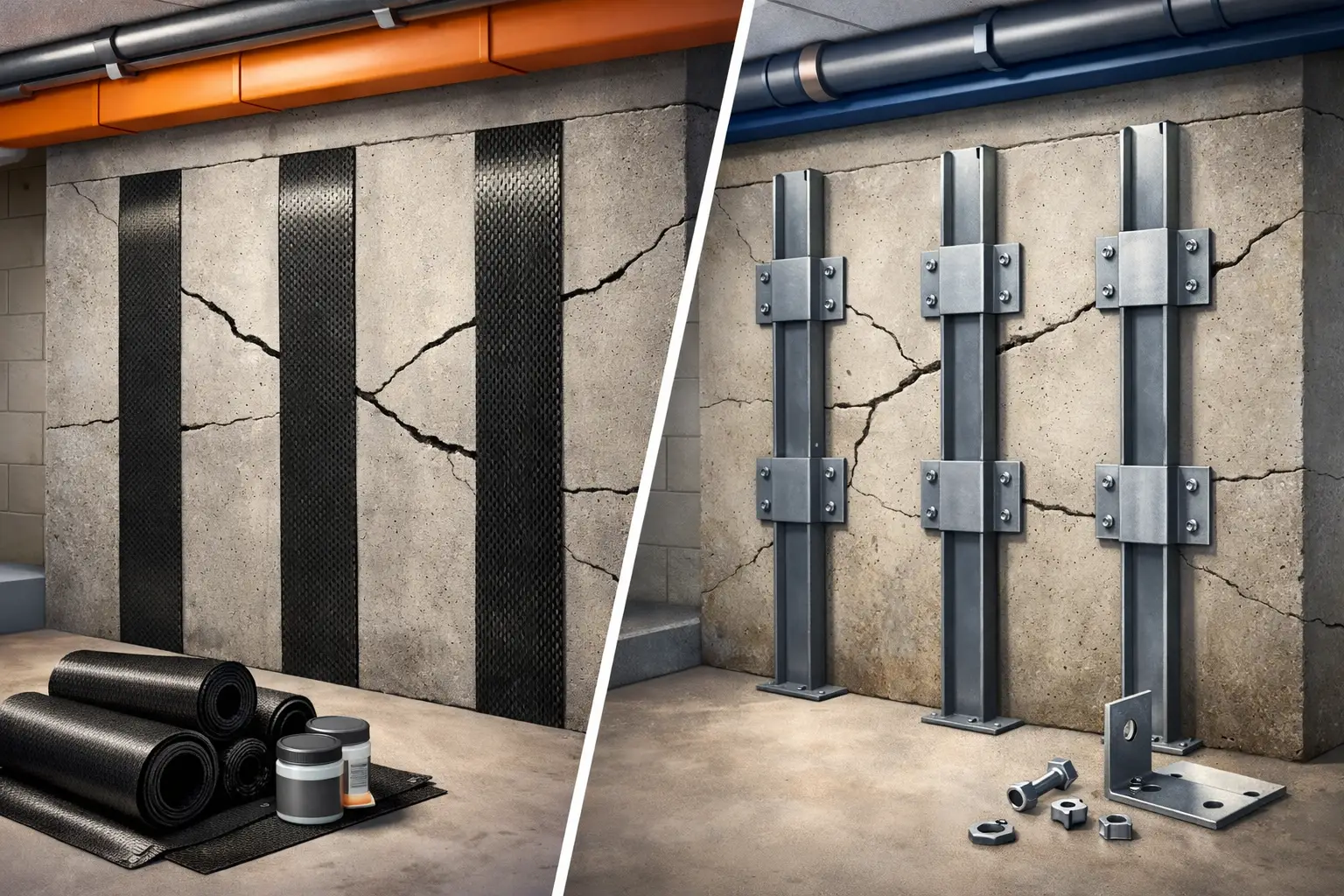
A horizontal crack across a basement wall, doors that begin sticking, or a wall that appears to lean inward can make any homeowner worry. When comparing carbon fiber vs steel for foundation wall repair, the right answer is not simply which material is stronger. It is which repair system fits the type and severity of movement, the wall construction, the forces acting outside the home, and the condition of the foundation itself.
Carbon fiber and steel are both proven reinforcement materials. Used correctly, either can be part of a permanent structural repair. Used for the wrong problem, however, even a high-quality product can fall short. A careful inspection should come before a recommendation.
Why Basement Walls Bow and Crack
Basement walls are built to carry the weight of the home above them. They are not meant to withstand unlimited sideways pressure from saturated soil. In Virginia and Maryland, heavy rains, poor drainage, expanding clay soils, and freeze-thaw cycles can all increase pressure against below-grade walls.
As that pressure builds, concrete block walls may develop horizontal cracks along the mortar joints. Poured concrete walls may crack, bow inward, or show displacement near the middle of the wall. Some homes also have contributing problems such as clogged gutters, short downspout extensions, grading that slopes toward the house, or groundwater collecting beside the foundation.
The visible crack is a warning sign, not a diagnosis. Before choosing carbon fiber or steel, a qualified professional needs to determine whether the wall is stable, actively moving, significantly displaced, or affected by another structural issue.
Carbon Fiber vs Steel: The Core Difference
Carbon fiber reinforcement is typically installed as high-strength strips or fabric bonded vertically to the interior face of a basement wall with a structural epoxy. The strips are designed to resist further inward movement while taking up very little space. Once installed, they sit nearly flat against the wall and can often be covered during a finished-basement renovation.
Steel wall reinforcement commonly uses vertical steel beams or channels anchored at the floor and framing above. Depending on the system and the wall condition, steel can be paired with adjustable components or other engineered supports. Steel is visibly more substantial and generally projects farther into the basement than carbon fiber.
Both materials have considerable strength. The practical difference is how each system performs in the field. Carbon fiber is a low-profile restraint system that works best where a wall can remain in place and needs protection against future inward movement. Steel can be the better choice when wall movement is more pronounced or when the repair design calls for a rigid, mechanically anchored support.
When Carbon Fiber Is Often the Right Choice
Carbon fiber is frequently a strong option for basement walls with early to moderate inward movement, horizontal cracking, or a history of soil pressure where the wall remains generally aligned. It is especially appealing in finished or partially finished basements because it does not take up meaningful floor space.
A properly installed carbon fiber system does not rust, does not require periodic tightening, and can be painted or concealed after installation. For homeowners trying to preserve usable basement space, that low-profile finish is a real advantage.
Carbon fiber also works well when the goal is to prevent additional movement rather than force a wall back into position. That distinction matters. A bowed wall does not always need to be straightened to be stabilized safely. Attempting to move masonry too aggressively can create new damage, particularly in older block walls.
Still, carbon fiber is not a universal solution. It depends on solid wall surfaces for proper bonding, and it may not be appropriate for walls with major displacement, deteriorated block, loose material, or conditions that require a different level of support. It also does not solve the exterior water or drainage issue creating pressure against the wall.
When Steel May Be the Better Repair
Steel is often considered for walls with more noticeable bowing, deeper displacement, or conditions where the repair plan requires a stiffer support system. Vertical steel reinforcement can distribute load over a broader area and provide a clear physical brace against continued inward movement.
For some homeowners, steel is also easier to understand at a glance. It is a substantial visible support attached to the wall and framing. In situations involving significant movement, that physical configuration may be better suited to the repair design than a bonded strip.
The trade-off is space and appearance. Steel beams extend into the basement, which may affect shelving, wall finishes, future remodeling plans, or access around mechanical equipment. Steel components also need to be installed with correct anchoring points. A beam is only as effective as the structure it transfers force into.
Not every bowed wall needs steel, and not every wall with a crack qualifies for carbon fiber. The amount of deflection, wall height, construction material, crack pattern, soil conditions, and signs of continued movement should drive the recommendation.
Strength Alone Does Not Decide the Repair
It is easy to frame carbon fiber vs steel as a contest of material strength. That misses the more important question: What is causing the wall to move, and what system is engineered to resist that specific force?
A concrete block wall with a long horizontal crack near mid-height behaves differently from a poured concrete wall with several vertical cracks. A wall that has bowed only slightly is different from one that has moved several inches. A repair plan must account for the home’s framing, the condition of the foundation, and whether moisture outside the wall is increasing lateral pressure.
Drainage correction is often part of protecting a structural repair. If roof runoff dumps beside the foundation or the grade directs water toward the basement, the soil can become saturated and heavy. Reinforcing the wall without addressing avoidable water loading may leave the underlying problem in place.
This is why cosmetic crack filling alone is not enough for an actively stressed wall. Filler may improve appearance and limit minor water entry, but it does not provide the structural restraint needed when soil pressure is pushing the wall inward.
Questions to Ask Before Choosing a System
A trustworthy inspection should give you a clear explanation of the wall condition and why a particular repair is being recommended. Ask whether the wall is actively moving, how much deflection is present, and whether the proposed system is intended to stabilize or straighten it.
You should also ask what is creating pressure outside the wall and whether drainage improvements are needed. If a contractor recommends carbon fiber, ask whether the wall surface and crack pattern are suitable for epoxy bonding. If steel is recommended, ask how the beams will be anchored and how much space they will occupy.
The goal is not to buy the biggest-looking repair. It is to install a system that addresses the actual risk without overselling work your home does not need. An honest evaluation may find that a small crack is non-structural. It may also identify a structural concern early enough to avoid a much larger repair later.
Protect the Wall Before Damage Grows
Foundation problems rarely improve by being ignored. A crack that stays dry and unchanged may be less urgent than a crack that is widening, leaking, or accompanied by bowing walls and sticking doors. The difference is not always obvious to a homeowner, which is why a professional assessment matters.
If you have noticed horizontal wall cracks, inward movement, water intrusion, or changes in your floors and doors, schedule a free inspection before choosing between carbon fiber and steel. Foundation Works evaluates the cause first, then recommends an engineering-based solution designed to protect your home, your family, and the value you have built in it.

